 On this page
- Key takeaways
- How much energy does a corporate screensaver use?
- Annual screensaver energy and cost impact per screen
- What does this mean for a 1,000-screen organisation?
- When is screensaver communication worth the energy use?
- What communication value can screensavers create?
- How can organisations reduce screensaver energy use?
- What is a responsible screensaver policy?
- How do screensaver, lock screen and wallpaper channels work together?
- Final answer: sustainability and communication can work together
- Frequently asked questions
 AI Summary
A corporate screensaver uses more power than a sleeping display, but when configured responsibly the additional energy cost can be modest. With a typical deskbound pattern of four 30-minute activations per day, this equates to approximately US$2.80 per screen per year. The best approach is to use screensavers as a controlled communication window, then allow the display or device to sleep.
Direct answer: A corporate screensaver does use more energy than sending a display directly to sleep, but the additional cost is usually modest when compared with the value of keeping your people informed, aligned, and inspired. In a typical deskbound scenario with four 30-minute screensaver activations per day, a standard display uses around 20 kWh of extra energy per year, that equates to approximately US$2.80 per screen per year. The key is to use screensavers as a purposeful communication window, then let screens sleep.
Key takeaways
| Question | Short answer |
|---|---|
| Do screensavers use extra energy? | Yes. A screensaver keeps the display active, so it uses more power than sleep mode. |
| Is the cost usually significant? | In the example used here, typical deskbound use costs approximately US$2.80 per screen per year. |
| Can the impact be managed? | Yes. Use short idle triggers, controlled screensaver run times, efficient displays, and sleep mode. |
| When is the trade-off justified? | When the screen time is used for meaningful communication, such as compliance, culture, safety, learning, change, or business updates. |
| What is the best approach? | Let screensavers run long enough to create communication value, then let screens sleep. |
How much energy does a corporate screensaver use?
The exact energy impact depends on the display model, brightness settings, content type, local electricity tariff, state, and device power management policy. The purpose of the following calculation is not to claim one universal number, but to give organisations a practical way to frame the trade-off.
For this example, we will use three simple assumptions:
- A conservative display power draw of 40 watts while active.
- Around 250 workdays per year.
- An illustrative U.S. commercial electricity rate of US$0.14 per kWh, based on recent U.S. Energy Information Administration commercial electricity price data
How to calculate screensaver energy cost
The annual cost per screen can be estimated using this formula:
Display wattage ÷ 1,000 × extra active hours per day × workdays per year × electricity rate = annual cost per screen
Using a typical deskbound pattern of two extra active screen hours per day, the calculation is:
40 ÷ 1,000 × 2 × 250 × 0.14 = US$2.80 per screen per year
Annual screensaver energy and cost impact per screen
| Daily screensaver pattern | Typical activations per day | Extra active time per activation | Total extra active screen time per day | Extra energy per screen per year | Approx. annual cost per screen at US$0.14/kWh |
|---|---|---|---|---|---|
| Occasional activation | 1 | 30 minutes | 30 minutes | 5 kWh | US$0.70 |
| Light activation | 2 | 30 minutes | 1 hour | 10 kWh | US$1.40 |
| Typical deskbound use | 4 | 30 minutes | 2 hours | 20 kWh | US$2.80 |
| Higher activation | 5 | 30 minutes | 2.5 hours | 25 kWh | US$3.50 |
What does this mean for a 1,000-screen organisation?
Under a typical deskbound scenario, where the screensaver activates around four times a day and each activation delays sleep by 30 minutes, the calculation is:
40 W × 2 hours per day × 250 workdays = 20 kWh per screen per year
At US$0.14 per kWh, that becomes:
20 kWh × US$0.14 = US$2.80 per screen per year
For a 1,000-screen organisation, that equates to approximately US$2,800 per year.
That is not zero, and it should not be dismissed. But it is also a relatively modest cost when compared with the value and cost of organisation-wide communication activity, especially when the screensaver window is controlled and followed by sleep mode.
When is screensaver communication worth the energy use?
Employee screensaver communications is most valuable when it turns otherwise idle screen time into a purposeful communication moment. For deskbound and hybrid employees, the screensaver can be one of the few communication channels that is both highly visible and low friction.
It does not rely on employees choosing to check an inbox, open an intranet, attend a meeting, or scroll through a collaboration feed. Instead, it appears when attention is naturally resetting: after a break, between tasks, after a meeting, or when someone returns to their desk.
That return-to-desk moment is valuable because it gives internal communication teams a chance to place important messages in front of employees without interrupting active work.
What communication value can screensavers create?
Used well, corporate screensaver software can support:
- Awareness: Surfacing important updates that might otherwise be buried in email or chat.
- Alignment: Reinforcing priorities, values, strategy, and workplace initiatives over time.
- Culture: Recognising people, celebrating milestones, sharing stories, and helping dispersed teams feel more connected.
- Compliance and safety: Reminding employees about cyber security, health and safety, policy changes, training deadlines, or operational requirements.
- Behaviour change: Repeating messages visually over time so they are more likely to be remembered and acted on.
- Learning and development: Delivering snackable, bite-sized learning messages at the right frequency, helping employees absorb key concepts over time without adding to their workload.
- Change programmes: Reinforcing key messages beyond one-off workshops, launch campaigns, or LMS modules so change initiatives have a better chance of embedding.
This is where the cost comparison becomes more meaningful. If the screensaver improves campaign participation, reduces missed deadlines, reinforces a safety message, or helps employees feel more connected to the organisation, the value can quickly outweigh a few dollars per screen per year.
How can organisations reduce screensaver energy use?
The strongest argument for the screensaver channel is not that energy use does not matter. It is that energy use can be managed with sensible settings.
A responsible configuration might look like this:
- The screensaver starts after a short idle period, such as 5 to 10 minutes.
- The screensaver runs for a controlled window, such as 20 to 30 minutes.
- The display or device then enters sleep mode.
There are also practical ways to reduce the energy impact:
- Use energy efficient displays where possible.
- Avoid unnecessarily bright content.
- Use light animation for everyday playlists.
- Reserve video or high-motion content for high-value campaigns.
- Set clear policies for when screens should sleep.
- Review screensaver content regularly so idle screen time is not wasted on outdated or low-value messages.
What is a responsible screensaver policy?
A responsible screensaver sustainability policy should treat the screensaver as a controlled communication window, not a reason to keep screens active indefinitely.
Every organisation will have different requirements, but the principle is the same: use the screensaver long enough to create value, then allow the display or device to sleep.
The real risk is wasted screen time. If a screensaver is filled with generic, outdated, or decorative content, the energy trade-off becomes harder to justify. But if the channel is used deliberately, it can turn an otherwise idle screen into a meaningful communication touch point.
The goal should be quality over quantity. Every message does not need to be urgent, but every message should have a purpose.
How do screensaver, lock screen and wallpaper channels work together?
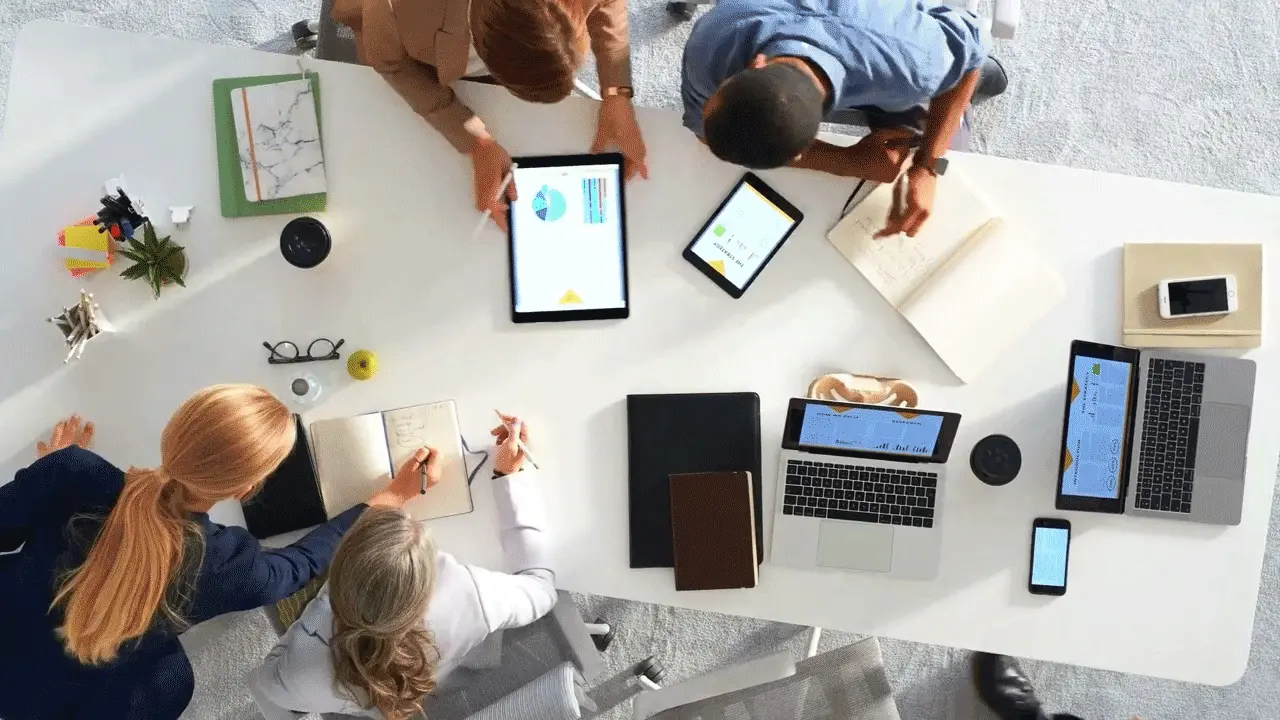
Lock screen, wallpaper, and screensaver channels each play a useful role in the digital workplace. Used together, they create a layered communication approach that reaches employees at different moments, with different messaging throughout the day.
Wallpaper provides a subtle, persistent backdrop for brand, values, campaign themes, or simple reminders.
The lock screen is useful for high-visibility messages at specific moments, such as pre-login, return-from-lock, or device start-up. It is ideal for security messages, important reminders, campaign prompts, or announcements that need to be seen before an employee begins their next work session.
The screensaver adds the dynamic layer, rotating fresh content during natural breaks in the workday and creating valuable return-to-desk moments for message reinforcement.
Together, these channels help organisations maintain visibility, consistency, and recall without relying solely on email, intranet posts, meetings, or collaboration tools.
Final answer: sustainability and communication can work together
Screensaver communication does create additional energy consumption when compared with sending a display directly to sleep. That should be acknowledged, measured, and managed.
When configured responsibly, screensaver communication can keep incremental energy use modest while delivering meaningful value through a more informed, aligned, and inspired workforce.
For example, a 1000-screen organisation, that could mean approximately US$2,800 per year. That figure is worth considering, but it is still small when compared with the potential value of improved awareness, engagement, compliance, learning, change reinforcement, and culture.
The most balanced position is not to choose between sustainability and communication. It is to design a smarter approach to both.
Let screensavers run long enough to create value. Then let screens sleep.




![64 Social Media Holidays for Your Internal Comms Content Calendar [NZ]](/media/website_posts/185/calendar-background.jpg)


![[UK] 8 ways to help your employees through the cost-of-living crisis that doesn’t involve a pay raise](/media/website_posts/179/personal-finances.jpg)





![[2022] 9 proven ways to influence employee engagement within the manufacturing sector](/media/website_posts/160/Mockup-Manufacturing-03-LTI.jpg)