 On this page
 On this page
- Q1: What defines success in internal communications?
- Q2: What is the biggest challenge facing internal communications in 2026?
- Q3: How important is workforce reach in proving the value of internal communications?
- Q4: How important is message repetition for retaining information?
- Q5: How important is measuring behavioural change in proving IC value?
- Q6: What KPIs are Internal Communications teams actually measured on?
- What the combined findings mean for Internal Communications leaders in 2026
 AI Summary
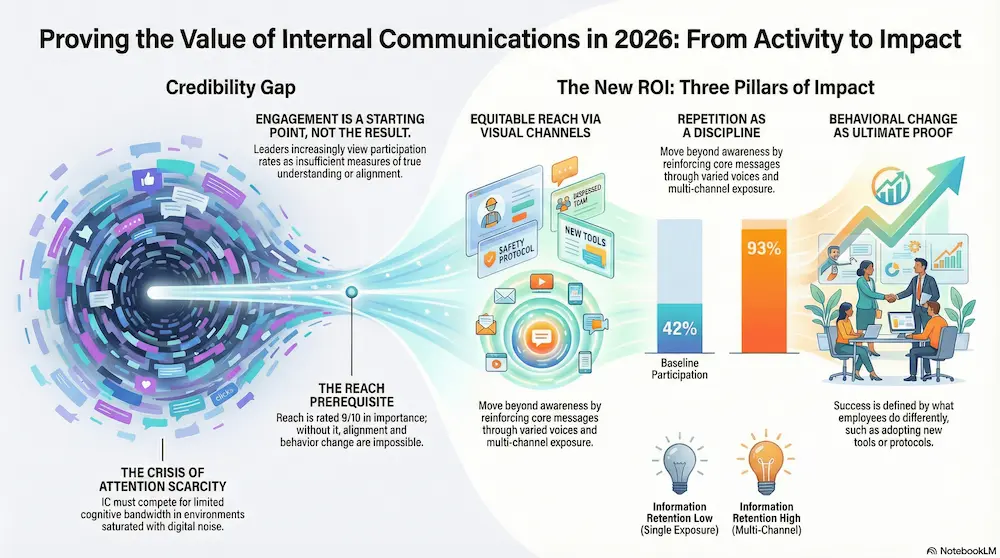
Internal communications teams are under pressure to prove real business impact in 2026. Success is increasingly defined not just by engagement metrics but by whether communications actually reach employees, are understood, align people with strategic priorities, and lead to measurable behavioural change. Many teams still rely on easy-to-get engagement data (like open rates and views), creating a credibility gap versus what leaders value most — outcome-based evidence that shows internal comms is driving real organisational results.
 Listen to the Podcast Episode:

This article summarizes the key messages from ActionHQ’s Measuring What Matters: Proving the Value of Internal Communications in 2026. A research report that captures how Internal Communications leaders and sector consultants across North America define success, including the push beyond engagement metrics toward reach, understanding, alignment, and measurable behavior change.
The participants represented more than 280,000 employees across mid-to-large organizations, averaging 6,000 to 7,000 employees and skewing heavily toward dispersed, hybrid, and frontline-heavy workforces. This context matters, as the report focuses less on whether IC teams are doing good work and more on whether they can reach employees equitably, reinforce messages without fatigue, and connect communications activity to outcomes senior leaders care about.
Across the findings, a clear pattern emerges. Leaders want success defined by reach, understanding, alignment, and behavioural change, yet many teams are still measured on engagement proxies or lack formal KPIs altogether. The result is a credibility gap where value is delivered but not consistently demonstrated in the language of impact.
Q1: What defines success in internal communications?
Engagement shows activity, but leaders want proof of impact
Internal Communications leaders most often point to employee engagement as the primary indicator of success. Participation rates, survey responses, and observable interaction with emails, intranet content, videos, and pulse surveys remain the most common measures in use.
However, engagement is widely viewed as a starting point rather than a sufficient measure of impact. While it is visible and easy to report, leaders consistently question whether engagement alone reflects true understanding or action. As one respondent noted, engagement does not necessarily translate into comprehension or application.
More mature definitions of success focus on understanding and recall. Leaders increasingly value whether employees can explain key messages, repeat core priorities, and meaningfully discuss what the organisation is doing and why. This shift elevates message reinforcement, not as a volume exercise, but as a deliberate strategy to build understanding through sustained, multi-channel exposure.
Organisational alignment also emerged as a critical success measure. Respondents described success as employees being aligned to leadership vision, business priorities, values, and purpose. This positions internal communications as an enterprise-level function that creates shared direction and cohesion, rather than simply distributing information.
Behavioural change represents the strongest proof of value. While mentioned less frequently than engagement or understanding, leaders described it with the greatest clarity. Success is ultimately defined by whether employees do something differently as a result of communications, such as adopting tools, complying with policies, prioritising initiatives, or changing everyday behaviours. As one leader framed it, ROI shows what was delivered, while “Return on Experience” shows what actually changed.
Executive takeaway:
Engagement remains a useful signal, but it is no longer enough. Internal Communications leaders want success defined by reach,
understanding, alignment, and measurable behavioural change. The shift is from activity metrics to outcome-based evidence that demonstrates
real organisational impact.
Q2: What is the biggest challenge facing internal communications in 2026?
Attention scarcity is not a moment, it’s the operating environment
Internal Communications leaders describe 2026 as an environment defined by attention scarcity. The core challenge is not message volume, but depleted employee attention. Workplaces are saturated with channels, tools, notifications, and competing priorities, leaving little cognitive bandwidth for internal communications that do not feel immediately relevant. Respondents consistently framed this as a structural reality rather than a temporary phase, with IC competing against both workplace noise and broader societal distractions.
Reaching dispersed and deskless employees remains an unresolved challenge. Manufacturing, frontline, and field-based workers often lack regular access to email or intranet tools due to role requirements, safety policies, or device restrictions. Leaders emphasised that this is not simply a channel issue, but an inclusion issue. When large segments of the workforce cannot reliably access information, organisations create unequal access to context, clarity, and decision-critical updates.
Artificial intelligence emerged as both an accelerator and a risk. Leaders recognise AI’s ability to improve speed and efficiency, but expressed concern about authenticity, quality, and trust. There is a clear tension between productivity gains and the risk of communications being perceived as generic or mass-produced. Respondents also rejected the idea that AI replaces the human dimension of internal communications, noting that judgment, context, ethics, and organisational nuance still require people.
Resource constraints continue to intensify these pressures. Many teams face rising expectations to deliver more content across more channels and demonstrate greater impact, without corresponding increases in staffing, time, or budget. Justifying investment in tools and platforms remains a challenge in this environment.
Underlying all of these issues is a broader question of legitimacy. Several respondents noted that Internal Communications leaders still lack a consistent seat at the table. Without proximity to strategy and decision-making, IC is expected to drive enterprise outcomes without the authority, access, or measurement frameworks needed to do so effectively.
Executive takeaway:
The challenge for Internal Communications in 2026 is not simply doing more. It is earning attention in a saturated environment, designing
equitable reach, using AI without eroding trust, and proving strategic value with constrained resources.
Q3: How important is workforce reach in proving the value of internal communications?
Reach is treated as the prerequisite for everything else

Workforce reach is viewed as foundational to internal communications success. Respondents rated its importance overwhelmingly at the top end of the scale, with most assigning scores of 9 or 10. The logic is clear and widely shared: if communications do not reach employees, IC cannot demonstrate understanding, alignment, or behavioural change. As one participant stated, “There is no communication without reach.”
Frontline and deskless employees remain the most difficult groups to reach equitably. The most frequently cited barriers include lack of access to email or intranet tools, device restrictions, and safety or role-based limitations. As a result, employees most affected by operational and organisational change are often the least connected to formal communication channels.
Workforce fragmentation further complicates reach. Respondents described employees spread across time zones, shifts, locations, and levels of digital access. In this environment, “one size fits all” approaches are ineffective. Achieving reach requires intentional, multi-channel design based on how and when different groups can realistically receive information.
The report also highlights that reach is not only about delivery, but about attention. Information overload and fatigue mean that messages can technically be sent without being meaningfully received. Effective reach depends on cutting through noise, not simply increasing distribution.
Leadership behaviour plays a critical role in reach outcomes. Supervisors and managers strongly influence whether messages are prioritised, shared, and acted upon, particularly for frontline teams. This reinforces reach as a shared organisational responsibility rather than a task owned solely by Internal Communications.
Executive takeaway:
Reach is universally recognised as essential, yet increasingly difficult to achieve. Workforce fragmentation, deskless realities,
information overload, and leadership prioritisation all determine whether communications are truly seen, understood, and acted upon.
Q4: How important is message repetition for retaining information?
Repetition is widely viewed as essential, but easy to misuse
Message repetition is widely viewed as essential for retaining information. Respondents consistently rated its importance between 7 and 9, with several assigning the highest score. Leaders recognise that complex messages rarely land after a single exposure, and that repetition helps move employees from initial awareness to deeper understanding over time.
At the same time, respondents warned that repetition is easy to misuse. Repetition without intent contributes to fatigue rather than retention. Increasing frequency alone does not improve outcomes if messages feel generic or excessive.
The most effective repetition strategies rely on multi-channel reinforcement rather than repetition within a single channel. Leaders described adapting the same core message across different platforms and environments, including email, intranet content, visual reminders, SMS or payroll inserts, and campaign-style approaches that place messages in multiple touchpoints. This increases the likelihood of exposure without overwhelming employees in any one channel.
Managers and leaders emerged as the most credible amplifiers of repeated messages. When information is reinforced by immediate supervisors, it carries greater relevance and urgency, particularly for frontline teams. Leadership reinforcement consistently strengthens both retention and action.
Respondents also emphasised that effective repetition requires variation. Repeating messages word-for-word was described as ineffective and counterproductive. Instead, leaders advocated reinforcing a stable core message through contextual examples, storytelling, and different voices to maintain relevance and attention.
Digital and human channels work best together. While digital platforms provide scale, live and interactive formats such as town halls, manager meetings, and video communications play a critical role in building trust and comprehension, especially during periods of change.
Executive takeaway:
Repetition is a discipline, not a volume exercise. It is most effective when the core message remains consistent, delivery is varied across
channels, and leaders reinforce messages in clear, human terms.
Q5: How important is measuring behavioural change in proving IC value?
Behavioral change is viewed as the clearest proof of IC value
Measuring behavioural change is viewed as critical, with most respondents rating its importance between 8 and 10. Leaders consistently agree that the purpose of internal communications is not information delivery, but influencing what employees do, decide, and prioritise across the organisation.
Behavioural change is most measurable during moments with clear, binary outcomes, such as compliance, safety, and adoption initiatives. Examples included uptake of safety procedures, adoption of new tools or systems, participation in programmes, and operational shifts that require new ways of working.
The strongest results occurred when communications were sustained and intentional. Targeted messaging, multi-channel reinforcement, and manager support drove significant gains, including adoption increases from 42 percent to 93 percent and rapid spikes in participation following reinforced communication.
Leadership behaviour is inseparable from employee behaviour. Communications can enable change, but leadership modelling and reinforcement legitimise action.
While behavioural change is widely valued, measurement is not always owned by Internal Communications. Outcomes are often tracked by HR, Operations, or other functions, limiting IC’s ability to consistently demonstrate impact.
Executive takeaway:
Behavioural change is the clearest proof of IC value, but fragmented ownership of measurement continues to limit visibility and recognition.
Q6: What KPIs are Internal Communications teams actually measured on?
Many teams lack a clear, consistent KPI
Many Internal Communications teams lack a clear, consistent KPI. Respondents frequently described performance measurement as informal, contextual, or transitional rather than anchored to a defined outcomes framework.
Where KPIs do exist, engagement metrics dominate. Open rates, intranet views, event attendance, and survey participation are commonly used as proxy measures, largely because they are available and easy to report, not because leaders view them as sufficient indicators of impact.
This creates a clear contradiction. While leaders acknowledge that engagement does not equate to understanding or behavioural change, engagement metrics remain the primary basis for evaluation.
Behavioural outcomes such as adoption, compliance, enrolment, or reduced support requests are recognised as strong indicators of value but are rarely embedded as ongoing KPIs. Instead, they tend to be measured on a case-by-case basis and often sit outside the ownership of Internal Communications.
When measurement is shared across functions, IC may contribute meaningfully to outcomes without being able to clearly demonstrate its impact. The report highlights the risk of this gap, noting that without outcome-based measurement, Internal Communications can be perceived as a cost centre rather than a driver of organisational performance and culture.
Executive takeaway:
There is a clear measurement gap between what IC leaders believe defines success and what they are formally measured on. Until outcomes such
as understanding, alignment, and behavioural change are embedded into KPIs, IC value will remain difficult to consistently demonstrate.
What the combined findings mean for Internal Communications leaders in 2026
While the report is structured around six questions, its implications converge into a clear agenda for the year ahead:
- Reach must be designed, not assumed. Hybrid, frontline, field-based, and deskless employees experience communications differently. Reach is an inclusion decision, not merely a channel decision.
- Repetition must be treated as a discipline. The goal is reinforcement through varied channels and credible voices, not higher volume of the same message.
- Behavioral change is the strongest proof of value, yet it is least measured. This creates a visibility gap between impact delivered and impact demonstrated.
- Measurement gaps create credibility risk. When engagement proxies stand in for outcomes, IC struggles to show strategic value even when it is real.
- Leadership reinforcement is non-negotiable. Managers and leaders are the force multipliers for reach, repetition, and behavior change.
The report’s closing reflection points toward a future state where IC moves beyond outputs and toward what it describes as “Data Impact”: the ability to show how communication influences understanding, alignment, and behavior at scale.
If you want the complete set of insights, not just the highlights, the full report provides the supporting detail to help you benchmark your approach and strengthen the case for outcome-based measurement.
Measuring What Matters: Proving the Value of Internal Communications in 2026

























-min.jpg)
-min.jpg)