 On this page
 AI Summary
Most digital signage software focus on displaying content repeatedly, assuming frequent exposure leads to better communication outcomes. The reality is employees often tune out predictable content, causing important messages to lose impact.
Vibe takes a different approach through memory-led visual communication. Helping organisations keep important messages fresh, engaging, and memorable. Rather than simply displaying content, Vibe is designed to reinforce key messages over time, helping organisations maximise attention, improve message retention, and drive greater alignment across their workforce.
Why message retention matters in digital signage
In every organisation, alignment is treated as a communication problem. Leaders send updates. Teams create campaigns. Important messages are pushed through email, intranet, chat, town halls, posters, newsletters, and digital screens.
But the real challenge is not simply whether a message has been sent.
The real challenge is whether it has been noticed, remembered, and reinforced often enough to influence behaviour.
That is where standard digital signage starts to fall short.
For many organisations, digital signage has become a playback tool. Content is uploaded, arranged into a playlist, scheduled across screens, and played on repeat. At first, the content may get attention. People notice the new campaign, the safety message, the values reminder, the leadership update, or the recognition story.
But over time, something predictable happens. The screen becomes familiar. The sequence becomes expected. The message becomes part of the background. What was once communication becomes visual wallpaper.
The message is technically still being displayed, but it is no longer working as hard as it should.
This is the gap Vibe is designed to close.
Vibe is pioneering memory-led digital signage software: a science-backed way to keep important visual messages fresh, engaging, and memorable, rather than letting them become repetitive screen noise.
This is a different way of thinking about digital signage. It moves the conversation away from “what is playing on the screen?” and towards a more important question:
What does the organisation need people to keep noticing, remembering, and acting on?
Standard digital signage is often built around repetition. The assumption is that if a message appears often enough, it will eventually land. But human attention does not work that simply. Repetition is important, but predictable repetition can have the opposite effect. When people see the same message in the same way, in the same order, day after day, they begin to tune it out.
This phenomenon is known as habituation, where repeated exposure to the same stimulus gradually reduces attention and response over time.
The issue is not that the message lacks importance. The issue is that the delivery has become too familiar.
This is why Vibe’s approach is different.
Instead of simply repeating messages until people tune out, Vibe uses science-backed
spaced repetition
to keep important messages alive, fresh, and memorable. It is not repetition for repetition’s sake. It is reinforcement with
rhythm, variation, and intent.
Decades of research into the spacing effect have shown that information is retained more effectively when exposure is spaced over time rather than repeatedly presented in a concentrated block.
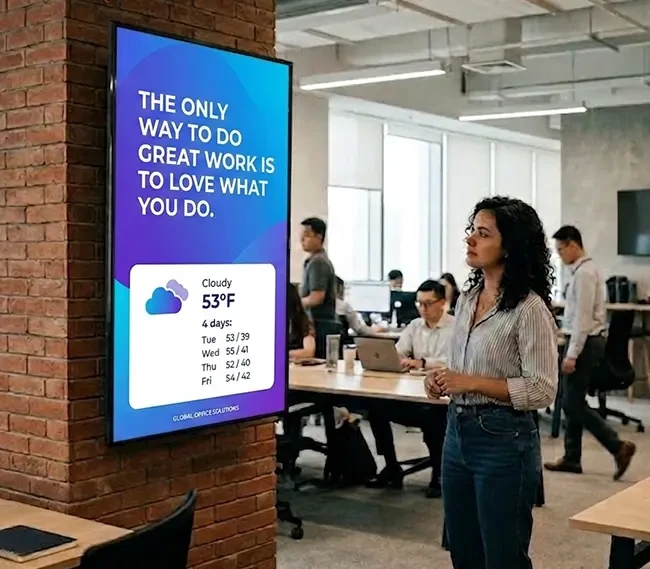
Vibe’s intelligent shuffle play helps prevent workplace communication from becoming wallpaper. It keeps key messages fresh, visible, and memorable by rotating visual content across the moments, screens, and spaces employees naturally pass through every day.
This matters because attention is one of the most valuable and limited resources in any organisation.
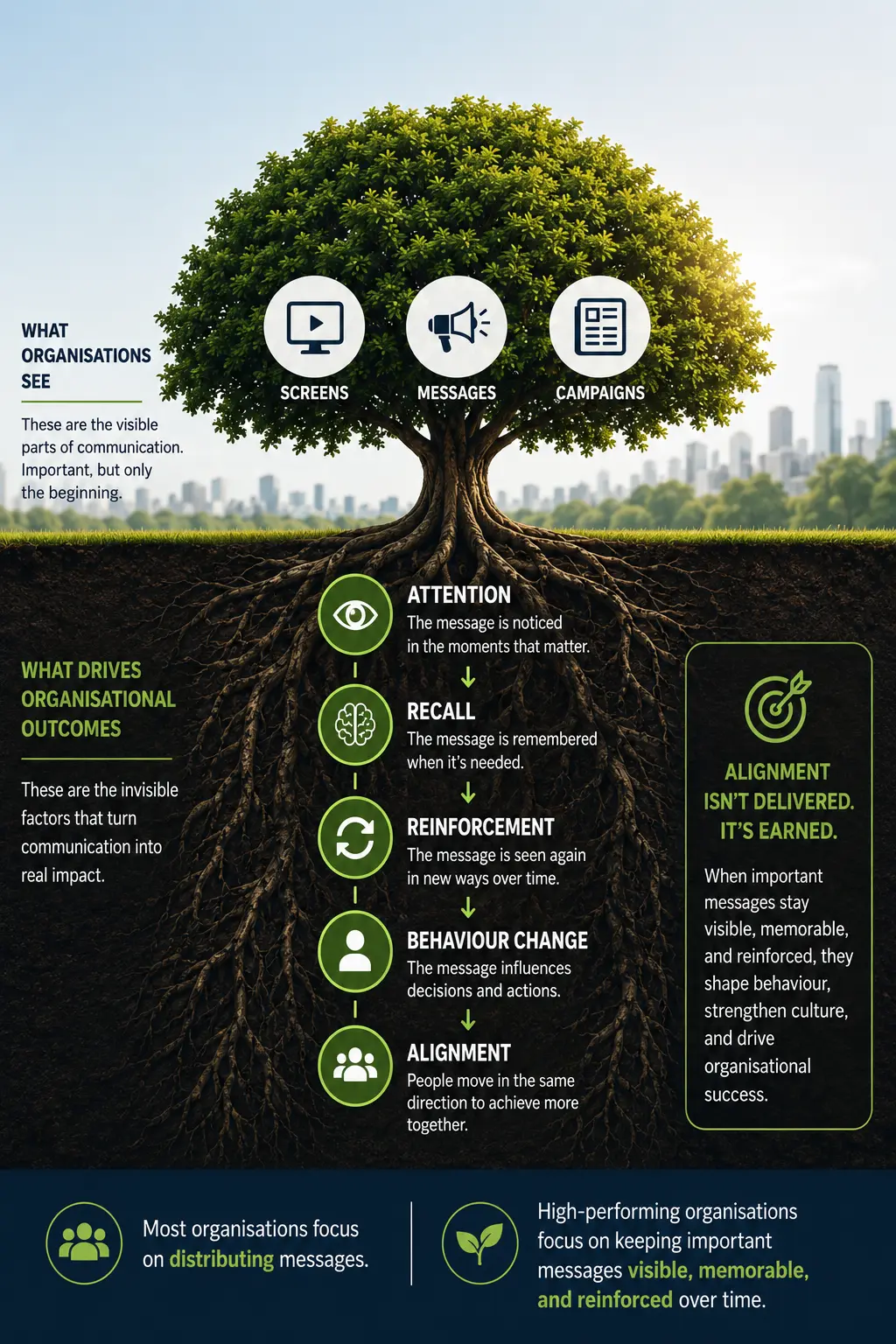
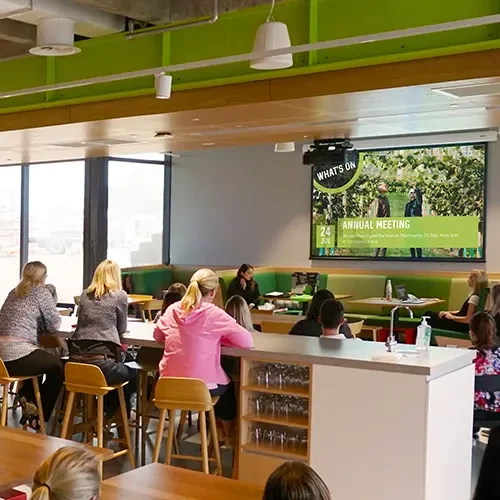
Every day, employees move through offices, meeting rooms, shared spaces, and digital touchpoints. These moments represent opportunities where Internal communication can meet people in the flow of work to reinforce culture & compliance, communicate priorities, celebrate success, improve safety awareness, and support change initiatives.
But these attention moments are fleeting.
Once someone walks past a screen, that opportunity is gone. Once a campaign becomes predictable, its effectiveness starts to fade. Once content becomes wallpaper, communication loses its power.
The organisation that wins attention will win alignment.
Alignment is not created by sending one perfect message once. It is created through consistent reinforcement. People need to see priority messages more than once. They need to encounter ideas in different ways. They need reminders that feel fresh enough to notice and familiar enough to remember.
This is the psychology behind memory-led digital signage.
Vibe is not just helping organisations display content. It is helping them preserve the value of important communication by keeping messages alive for longer.
A safety message should not disappear after launch week. A culture campaign should not become stale after the first few days. A leadership priority should not be buried in a channel people are too busy to check. Recognition stories should not be seen once and forgotten. Change communication should not rely on a single announcement and hope.
Important messages need movement. They need visibility. They need variation. They need to resurface at the right moments.
Vibe's intelligent shuffle play helps prevent this by continuously refreshing how messages are presented. Important content reappears over time, but not in a way that feels repetitive. Messages remain visible, relevant, and engaging across the moments, screens, and spaces employees naturally pass through every day.
The result is a fundamentally different approach to visual communication.
Traditional digital signage and screensaver software rely on repetitive content. Vibe uses spaced repetition to strengthen memory retention.
Where traditional signage repeats messages until they risk blending into the background, Vibe reinforces them with rhythm, variation, and intent. Key messages are refreshed over time, helping them stay visible, memorable, and more likely to influence behaviour.
This distinction becomes increasingly important as organisations invest more time and effort into communication campaigns. Whether it's a safety initiative, cultural or digital transformation programme, leadership message, recognition campaign, or strategic priority, success depends on more than simply publishing content. It depends on whether people continue to notice, remember, and act on it.
Every day, valuable employee attention is being missed. Critical messages go unseen, campaigns lose momentum, screens sit underused, and culture moments pass before they can make an impact. Vibe helps you capture those moments and turn them into meaningful workplace communication.
The future of digital signage isn't simply displaying more content. It's ensuring the content that matters most remains visible, memorable, and influential.
Because in a workplace full of competing priorities, the organisations that win will not be the ones that simply send the most messages. They will be the ones that make their most important messages stick.
In today's workplace, the organisation that wins attention will win alignment.
Further Reading
Frequently Asked Questions About Memory-Led Digital Signage Software
About the Author

Vaughan Reed has over 20 years of experience in the digital communication space, driven by a core belief that effective communication is mission-critical for organisational success. As Founder and CVO of Vibe.fyi, he helps communication teams connect with hard-to-reach, hybrid, and deskless employees through vibrant, visual content that's seen often and a part of the daily rhythm at work. Vibe's purpose-built SaaS platform delivers compliance, wellbeing, safety, and culture-building messages across everyday digital touchpoints, from communal screens to desktop and browser displays, transforming workplace communication for the modern era.